


 Sharmion Kerley, MIPI Director of Marketing and Membership
New Birds of a Feather Group open to both MIPI members and non-members
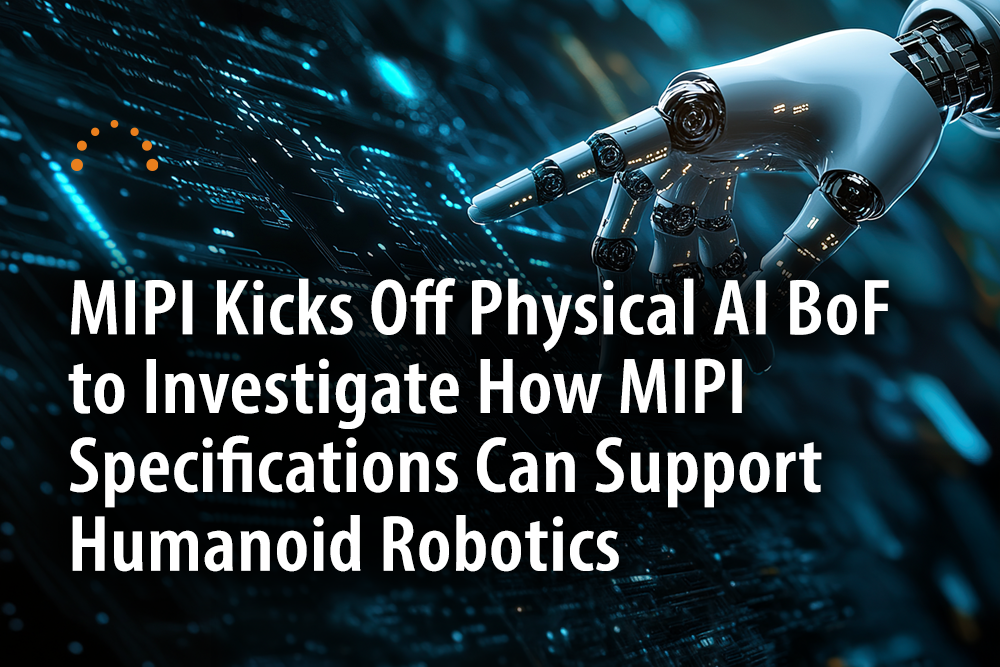
The robotics industry is entering a new phase, as humanoid systems move from research labs and proof of concept to commercialization. To explore how MIPI may be able to help the market scale, and alleviate interoperability and integration challenges, MIPI recently launched a new Physical AI Birds of a Feather (BoF) group, with an initial focus on humanoids.
MIPI members and non-members are invited to learn more about the BoF and sign up to participate.
Exploring the Humanoid Market
The group’s first two meetings in April and May featured analysts who shared their perspectives on where the market is headed, and what barriers and opportunities exist. The first presentation was delivered by Zach Haines, Samsung senior manager, Strategy & Market Intelligence at SSIC; the second was a detailed market and technology presentation from Pierrick Boulay, principal analyst, automotive & semiconductors, at Yole Group.
Both sessions brought out similar themes, particularly the heavy investment and rapid expansion of the humanoid market, as well as the growing need for standardization to enable faster system integration, reduced development complexity, lower implementation costs and improved interoperability across components and subsystems.
Participants also noted that this is an ideal opportunity for companies to collaborate before architectures and supply chains become dependent on proprietary solutions.
In a poll conducted during the meeting, attendees were asked how long they believed it will take for humanoids to become mainstream:
- 44% predicted within five years
- 50% predicted within 10 years
- Only 6% believed it would happen within two years
As a significant indicator, some participants suggested that the long-term semiconductor opportunity for humanoids could eventually rival markets as large as smartphones or autonomous vehicles.
How MIPI Specifications Could Be Leveraged Within Humanoids
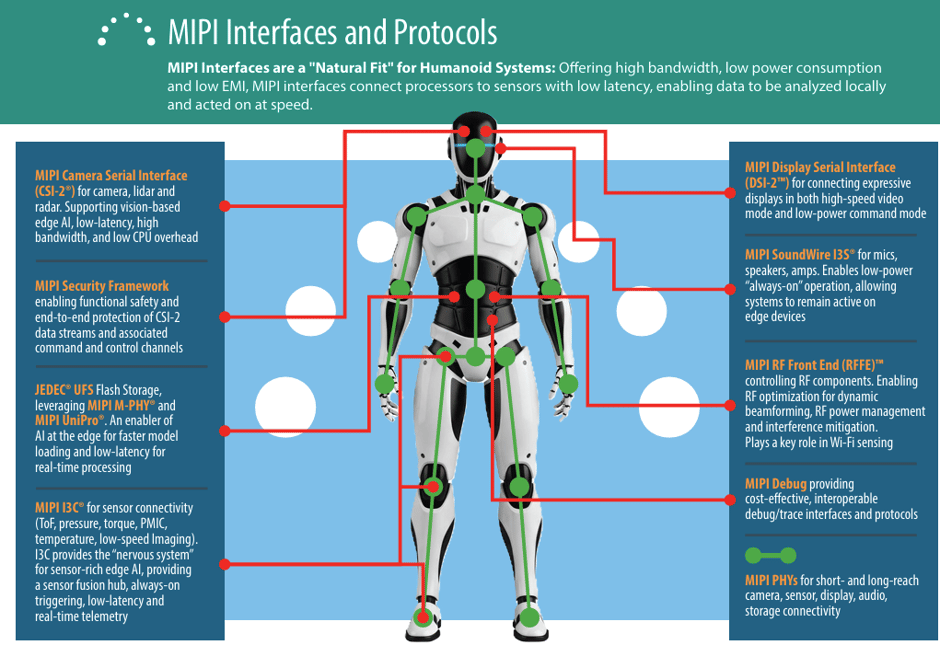
Given MIPI’s long history of enabling standardized mobile and other connected-device ecosystems, the adoption of standards during this early commercialization phase could positively impact the emerging market. Participants highlighted several examples of where existing MIPI specifications could potentially support humanoid systems. The image below summarizes the advantages these MIPI specifications could offer.
The Challenges Ahead
Despite the growing opportunities, the discussions also highlighted several hurdles.
Cost emerged as the greatest concern in a poll of BoF participants, with 56% identifying it as the biggest barrier to humanoid market success. Hardware challenges followed at 31%, while software was cited by 13% of respondents. Yole Group’s bill-of-materials analysis helps explain why: Dexterous hands and actuators alone account for roughly 73% of total hardware cost, with hands representing the single largest line item.
Another concern focused on the challenges of humanoid design, including balancing dynamics and operating in human-designed environments. Participants emphasized the need for safety, reliability and cost-effectiveness in humanoid technology development.
Also noted was the current lack of real-world robotics training data. Unlike autonomous driving or mobile applications, humanoids still lack the massive volumes of operational data needed to fully train AI models for dynamic physical environments. To compensate, many developers are currently forming partnerships to expand access to robotics-specific data collection.
Geopolitical dynamics are also coming into play. Participants discussed China’s growing investments and government-backed subsidies aimed at expanding domestic robotics manufacturing and AI development capabilities. Time will tell whether the global market will eventually split into parallel ecosystems, whether any one region may ultimately achieve scale advantages, or whether the global market will coalesce regardless of geographic boundaries.
How to Become Involved
The new group is actively seeking contributions from member and nonmember companies interested in helping define use cases, architectures and areas where standardization leveraging MIPI specifications could benefit the broader humanoid ecosystem.
Is your company exploring this emerging market? Join the MIPI Physical AI BoF Group by filling out this interest form: https://www.mipi.org/mipi-physical-ai-bof-participation.