


MIPI SyS-T™
MIPI System Software Trace
.png?width=1200&height=600&name=Banner%20Images%20-%20MIPI%20(26).png)
MIPI System Software Trace (MIPI SyS-T™) is a common data format for transmitting software trace and debug information between a test system and a device, such as a system-on-chip (SoC) or platform.
The specification is publicly available to developers, and an accompanying example implementation is available via GitHub: Instrumentation Library on GitHub.
Legacy Debug Solutions
MIPI SyS-T addresses a very real need in the debug and test industry for a universal data format that can be used to exchange debug information across software, firmware or hardware implementations. It provides a convenient, vendor- and OS-agnostic approach to alleviate fragmentation caused by solutions associated with specific vendors or operating systems. It complements the MIPI Alliance debug and test portfolio because it can be used with any MIPI Alliance debugging tool or transport protocol.
Developers will find that MIPI SyS-T makes it easier to integrate their embedded software with underlying hardware. It enables hardware vendors to use software solutions from more organizations. Debug and test tooling vendors can use the specification to offer generic testing products for developers and manufacturers.
Key Capabilities
The specification includes the trace formatting method as well as an optional MIPI SyS-T Instrumentation Library, which includes APIs and documentation that developers can use to jumpstart their use of the specification rather than starting from scratch.
MIPI Alliance encourages developers to use, modify and share the example SyS-T library, provide feedback and interact with others in the user community.
Software
The Instrumentation Library for MIPI SyS-T includes APIs and documentation to help developers jumpstart their use of the specification, a universal data format used to exchange debug information across software, firmware or hardware implementations. It includes the following additional components to provide a working trace cross debug solution:
- An example implementation for a MIPI SyS-T data protocol printer for converting the binary protocol into comma separated value (CSV) text format
- A PERL based collateral generator that automates the creation and updating of MIPI SyS-T decode collateral in XML format
- Doxygen based documentation for the instrumentation library
- A unit test suite for the instrumentation library
The library is designed to have minimal dependencies for building. Its core is written using self-contained C-language code. Only the platform dependent adaptation software layer relies on C-runtime headers and libraries. The protocol printer is written in C++11 and requires a C++11 compliant compiler and runtime environment.
MIPI Alliance encourages developers to use, modify and share the example SyS-T library, provide feedback and interact with others in the user community.
Diagrams & Tables
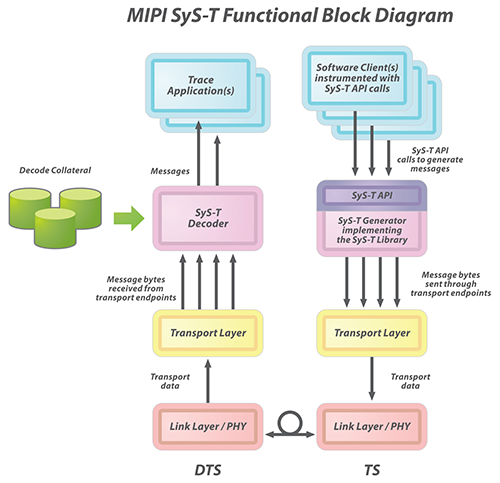
SyS-T Functional Block Diagram
(click to enlarge)