




 Ian Smith, MIPI Alliance Technical Content Consultant

As the need for security becomes increasingly more critical, MIPI Alliance has continued to broaden its portfolio of standardized solutions, adding two more specifications in late 2025, and continuing work on significant updates to the MIPI Camera Security Framework specifications slated for completion in mid-2026.
Read on to learn more about the newly released specifications and what lies ahead for the MIPI Camera Security Framework.
MIPI CCISE: Protecting Camera Command and Control Interfaces
The new MIPI Command and Control Interface Service Extensions (MIPI CCISE™) v1.0, released in December 2025, defines a set of security service extensions that can apply data integrity protection and optional encryption to the MIPI CSI-2® camera control interface based on the I2C transport interface. The protection is provided end-to-end between the image sensor and its associated SoC or electronic control unit (ECU).
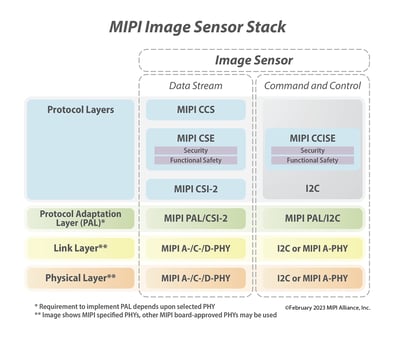
MIPI CCISE rounds out the existing MIPI Camera Security Framework, which includes MIPI Camera Security v1.0, MIPI Camera Security Profiles v1.0 and MIPI Camera Service Extensions (MIPI CSE™) v2.0. Together, the specifications define a flexible approach to add end-to-end security to image sensor applications that leverage MIPI CSI-2, enabling authentication of image system components, data integrity protection, optional data encryption, and protection of image sensor command and control channels. The specifications provide implementers with a choice of protocols, cryptographic algorithms, integrity tag modes and security protection levels to offer a solution that is uniquely effective in both its security extent and implementation flexibility.
Use of MIPI camera security specifications enables an automotive system to fulfill advanced driver-assistance systems (ADAS) safety goals up to ASIL D level (per ISO 26262:2018) and supports functional safety and security mechanisms, including end-to-end protection as recommended for high diagnostic coverage of the data communication bus.
 While the initial focus of the camera security framework was on securing long-reach, wired in-vehicle network connections between CSI-2 based image sensors and their related processing ECUs, the specifications are also highly relevant to non-automotive machine vision applications that leverage CSI-2-based image sensors.
A downloadable white paper, A Guide to the MIPI Camera Security Framework for Automotive Applications, provides a detailed explanation of how these specifications work together to provide application layer end-to-end data protection.
MIPI Security Specification for Debug: Enabling Remote Debug of Systems in the Field
The recently adopted MIPI Security Specification for Debug defines a standardized method for establishing secure, authenticated debug sessions between a debug and test system and a target system.
 Designed to enable remote debugging in potentially hostile real-world locations outside of a test lab, the specification allows secure remote debugging of production devices without relying solely on traditional physical protections such as buried traces or restricted access to debug ports. Instead, it introduces a trusted, cryptographically protected communication path that spans end-to-end, from the physical debug tool to the target device’s package pins, through all connectors, cabling, routing and bridges.
The new speciation adds a secure messaging layer to the existing MIPI debug architecture, wrapping debug traffic in encrypted, authenticated messages while remaining interface-agnostic. Core components include a secure communications manager that is responsible for security protocol, data model processing and key generation; cryptographic message-protection functions; and secure communication management paths. To accomplish this, the specification leverages the DMTF Security Protocol and Data Model (SPDM) industry standard for platform security.
This approach ensures authenticity, confidentiality and integrity for all debug communications, regardless of the underlying transport interface, whether MIPI I3C®, USB, PCIe or others. Debugger behavior remains consistent across interfaces, simplifying implementation and validation.
The specification complements the broader MIPI debug ecosystem.
Coming in 2026: New "Fast Boot" Options for MIPI Camera Security
Enhancements to the suite of MIPI camera security specifications are being developed to enable faster boot times for imaging systems, minimizing the time taken from power-on to streaming of secure video data.
These enhancements will continue to leverage the DMTF SPDM framework and message formats, but will introduce an optional new security mode that will half the number of security handshake operations required to complete the establishment of a secure video streaming channel compared with currently defined security modes. Image sensors will be able to implement both current and new modes of operation to provide backward compatibility, and SoCs may only require software updates to implement the new mode of operation.
Both the MIPI Camera Security and the MIPI Camera Security Profiles specifications are scheduled to be updated to v1.1 in mid-2026. However, the companion specifications that will fully enable the enhancements, MIPI CSE v2.1 and the new CSE Exchange Format (EF) v1.0, will follow later this year.
All security specifications are currently available only to MIPI Alliance members.